
23 October 2026 posted by Recovery Partners
Effective workplace injury management is crucial for all workplace injuries. Return to work programs and injury management programs play an important role in this. Although both are crucial, a RTW Program and injury management program each have their own key responsibilities and requirements under NSW legislation that are crucial to recovery. This blog will discuss return to work programs and injury management programs in NSW, their key differences and how they are both important parts of an injured worker’s recovery process.
What is a Return to Work (RTW) Program?
According to SIRA, a return to work program “is the formal policy that outlines general procedures for handling work related injury or illness” (State Insurance Regulatory Authority, 2025). They are an important commitment to the wellbeing, health and safety of workers by their employer.
In NSW, there a variety of key requirements for return to work programs, including:
- All NSW employers must establish a RTW Program, and Category 1 and Category 2 employers must do so within 12 months of joining either category.
- Programs must align with the insurer’s injury management program and be developed alongside workers and any industrial union.
- RTW programs must be created in compliance with SIRA’s ‘Guidelines for workplace return to work programs’.
- Programs must be accessible to employees and reviewed at least every two years.
It is also important to note that Category 1 and Category 2 employers have different requirements for their return to work programs.
Category 1 Employers include those who are self-insured, insured by a specialised insurer, have more than 20 employees, and exceed a $50,000 basic tariff premium annually.
These employers must do the following to create a RTW program:
- Appoint a RTW coordinator.
- Create a RTW program.
- Engage workers and unions in their consultations.
- Put the RTW program into practice.
Category 2 Employers are those who do not fit the Category 1 conditions. When developing a RTW program, they must:
- Designate a person to oversee recovery at work.
- Create a RTW program.
- Put the RTW program into practice.
What is an Injury Management Program?
An injury management program on the other hand shifts the focus towards insurers. According to SIRA, Section 42 of the 1998 Workplace Injury Management and Workers Compensation Act, an injury management program is a “co-ordinated and managed program that integrates all aspects of injury management (including treatment, rehabilitation, retraining, claims management and employment management practices) for the purpose of achieving optimal results in terms of timely, safe and durable return to work for injured workers” (State Insurance Regulatory Authority, 2021 ). This program is established and maintained by insurers.
An injury management program should:
- Comply with NSW workers compensation legislation.
- Be developed within the guidelines of Section 42 of the 1998 act.
- Outline an efficient process for the management of workplace injuries.
- Support employers in developing their return to work program.
As an injury management program is established and maintained by insurers, there are a variety of responsibilities and obligations insurers must uphold with their programs. These include:
- Establish, maintain and regularly review the injury management program, including when directed by SIRA.
- Lodge the injury management program and any updates with SIRA.
- Scheme agents must provide the injury management program and any updates to the Nominal Insurer.
- Implement and comply with all requirements outlined in the injury management program.
- Ensure employers understand and meet their workplace injury management obligations.
- Initiate the injury management program within three working days of notification of a significant injury and promptly contact the worker, employer and treating doctor where appropriate.
In order to create appropriate procedures for insurers to optimise their claimants return to work results, these procedures within an injury management program should align with the claims management principles.
- Fairness and empathy – ensure workers know their entitlements, rights and responsibilities.
- Transparency and participation – communication is timely and efficient.
- Timeliness and efficiency – responding to inquiries, processing claims and payments in a timely manner.
SIRA provides an example template of how an insurer may structure an injury management program, the key sections include:
- Introduction.
- References.
- Stakeholder obligations, rights and responsibilities.
- Return to work.
- Claims management.
- Treatment and medical intervention.
- Employer management practices (State Insurance Regulatory Authority, 2021).
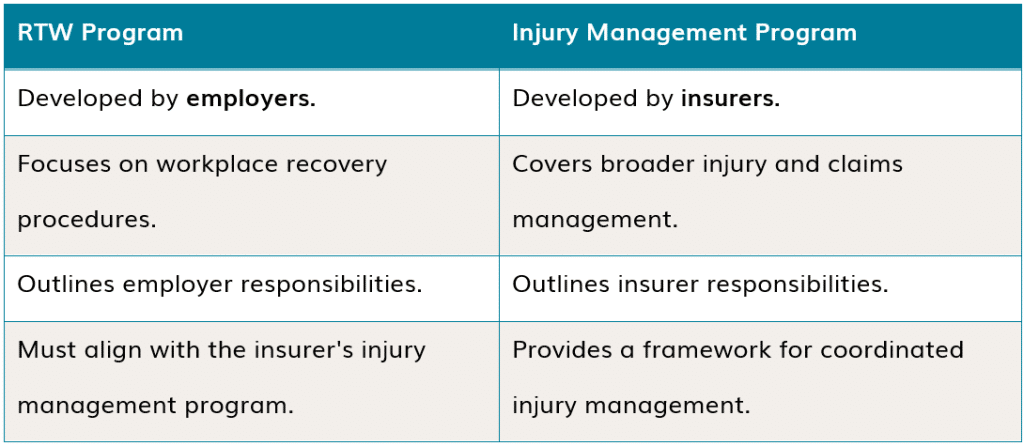
Key Differences
Why Are Both Important?
A RTW Program and injury management program are both important parts of the recovery process, as they work collaboratively to achieve safe and sustainable return to work outcomes. The two programs work together to support timely intervention, communication between stakeholders, compliance and positive return to work outcomes. They both promote early intervention, ensure processes are in place to avoid workplace injuries and provide the best ways moving forward when an injury does occur. An employer’s RTW program must align with their insurer’s injury management program, therefore, in order to be effective each program works alongside each other to achieve meaningful goals.
How Recovery Partners Can Help
Understanding the difference between a RTW Program and injury management program is important for NSW employers to ensure they meet their obligations and effectively support injured workers.
At Recovery Partners, we provide tailored Outsourced Return to Work Coordination and Workplace Rehabilitation services to help employers navigate their responsibilities, manage workplace injuries and achieve positive return to work outcomes. Our experienced consultants work closely with employers, injured workers and insurers to facilitate a safe, timely and sustainable return to work.
Contact our team today to learn how we can support your workplace injury management and return to work needs.
Want to find out more?
Our services are available nationwide. Our consultants love to have a chat, so go ahead and give us a call on 1300 OHS RTW (647 789) or email enquiries@rrp.com.au
You may be interested in:
If you enjoyed our blog post on the ‘What Is the Difference Between a RTW Program and Injury Management Program?’ you may also be interested in:
Disclaimer – these articles are provided to supply general safety information to people responsible for OHS in their organisation. They are general in nature and do not substitute for legal and/or professional advice. We always suggest that organisations obtain information specific to their needs. Additional information can be found at https://www.safeworkaustralia.gov.au/
Recent Posts
How Pre-Employment Medicals Can Help Reduce Workplace Injury Risks
8 October 2026Investing in Injury Prevention: The Significant Cost Benefits of Pre-Employment Health Assessments
2 October 2026An Employer’s Guide to Managing Psychological Claims
25 September 2026How to Choose the Right Ergonomic Office Chair for Your Workstation
18 September 20265 Things Employers May Overlook During the Recruitment Process